If you’ve spent time walking the shores or paddling the coastlines of Galiano, you’ve likely noticed kelp washed up on beaches or floating in the ocean. Q’am’, or bull kelp, is a classic sight around the Salish Sea, with its whip-like stipe, flowing blades, and bulb-shaped float.
Multiple kelp forests surround Galiano Island, providing critical habitat and feeding grounds that support a wide range of marine life like sea stars, rockfish, otters, herring, and much more.
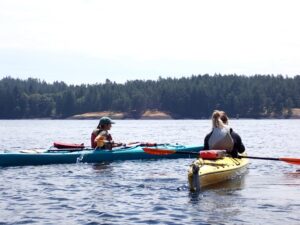
GCA-staff-and-volunteers-mapping-kelp-2024
These ecosystems hold immense value, and have the ability to trap and store carbon, up to 10 times more than land forests, which is becoming increasingly important in the face of climate change.
Kelp forests have been declining throughout the Salish Sea due to a range of pressures, such as pollution and climate change. This has a ripple effect across marine ecosystems, impacting many forms of ocean life from algae to orcas.
The Galiano Conservancy Association (GCA) has been mapping kelp forests surrounding the island since 2016 to get an understanding of the changes within these ecosystems. This data is collected throughout August from five kelp beds bordering the island. At low tide, when the kelp beds are most visible, GCA staff and volunteers kayak around the border of the kelp forests with a GPS to map out their size. This data is compared with past years to detect changes within the kelp beds.
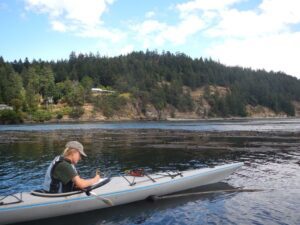
Sofia mapping kelp 2024
Interested in helping out? Volunteers are always welcome! Bring your own kayak if you can; if not, we have some available, and join us in monitoring these important marine ecosystems.
Email oceans@galianoconservancy.ca to get involved!