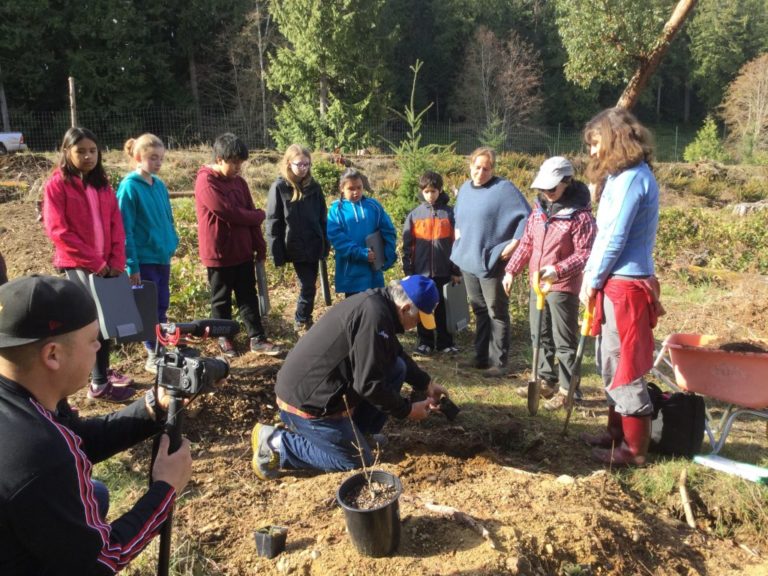
AN ARTICLE BY ZORYAN IVAKHIV-GRAY
We’re delighted to share an article by Zoryan Ivakhiv-Gray, a young, avid permaculture practitioner and dedicated pollinator advocate who recently returned from a summer tour of permaculture farms, both locally and abroad.
Currently living in the Lower Mainland, and a regular volunteer with the GCA, Zoryan has become passionate about the GCA’s work, and has contributed to both our sustainable food systems and restoration projects. He also co-hosted The Pollinator Report, a Central Vermont Community Radio (WGDR/WGDH) show exploring pollinators, ecology, and community action; readers can access its archives through the link provided below.
His writing brings firsthand observations from farms abroad into conversation with the practical questions facing growers, gardeners, and restoration practitioners closer to home.
_________________________________________________________________________________________________
Last summer, I had the fortune to visit Le Ferme Biologique du Bec Hellouin & Ecole de Permaculture (Bec Hellouin Organic Farm & School of Permaculture) in Normandy, France, alongside other oases of food sovereignty and biodiversity recovery in BC and my old home of Vermont in the US. It was both relieving and uplifting to see how communities can regenerate their soil, pollinators, wildlife, food systems and become (re)grounded in the land—all in the face of climate stress—and that the GCA’s amazing work in regenerating Galiano’s food systems is not alone.
When I visited Normandy with my Vermont farmer-mentor Carol Fairbank, France was in the midst of a major heatwave of 40+ degrees. This heatwave was especially noticeable in Paris, where people struggled through the muggy heat, while the temperature dropped somewhat in the countryside. (Although some ‘cooling vegetation islands’ in Paris may have helped slightly!) However, even in the countryside, it was evident that many farm crops were struggling, and wheat was drying prematurely before grain had formed.
The Ferme du Bec Hellouin, surrounded by lush edible hedgerows and filled with a diversity of different agro-ecological plots—forest garden (similar to the GCA’s), self-watering island ‘chinampa’ gardens, permacultural greenhouses with mini ponds, pasture-orchards—was still thriving, with most crops protected by the shade of trees integrated into the landscape and the cooling effect of ponds. An extra-deep, willow-shaded, pond for livestock watering and human use furthered the feeling of this place as a regenerative oasis of life, surrounded by unreliable monoculture.
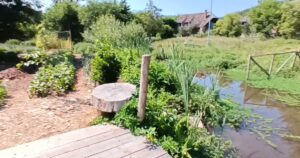
Ferme du Bec Hellouin’s stream
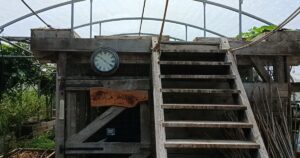
Ferme du Bec Hellouin’s self-heating greenhouse and chicken coop
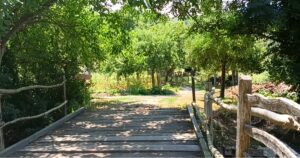
Ferme du Bec Hellouin’s gardens
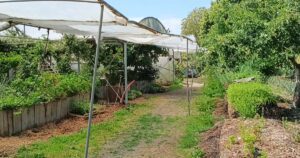
Ferme du Bec Hellouin’s self-heating greenhouse
This farm was founded in 2004 by Charles and Perrine Herve-Gruyer, after which it gradually took the form of a detailed permaculture agroecological design, and has been the site of a number of notable studies proving the agricultural, ecological, and carbon-sequestering efficiency of such a diversified regenerative ‘microfarm’ over conventional organic farms. In fact, one study demonstrated that their ‘intensive heart’ gardens produced 10x higher yields with manual methods than a typical mechanically-managed conventional organic farm!
Charles and Perrine’s first book, Miraculous Abundance, a memoir account of their family’s journey in experimental regenerative farming methods, helped me connect and bond with farmers, gardeners, and other agroecology-minded people when I lived in Vermont, including the farmer I travelled with to visit. The Ferme du Bec Hellouin has done an amazing job of melding methods of permaculture (a ‘design system for resilient living & land use based on universal ethics and ecological design principles’ – David Holmgreen), agroecology (ecologically-aware farming), Grow Biointensive gardening (a system developed by John Jeavons in the 70s melding biodynamic and French intensive methods), intensive methods from French cities and traditional orcharding and hedgelaying, and other techniques from around the word (e.g. the chinampa garden); in a way that allowed their farm to best synergise with and produce from its local ecosystem. They also stress utilizing animals to complete the agro-ecosystems cycles, as they did in their greenhouse with a thermal-regulating, composting, chicken coop with growing space on top.
These methods were standardised in the Herve-Gruyer’s 3-volume manual Living With the Earth, and have been used by regenerative farms where I’ve worked. Meeting Charles and visiting the farm during the unforgettable heatwave only proved how locally-adapted such a system must be, although myself and my farmer-mentor both took home a number of ideas for our own gardens (and her Broadfork Farmstead in Vermont), not the least being to include more cooling water sources, which Carol is currently working on implementing.
Alongside Normandy and the Northeast/Vermont area, the Pacific Northwest we live in is another center for regenerative food systems development. In August, I spent some time at Gibsons Farm & Camps in Gibsons, which has successfully integrated a producing vegetable and fruit/hazelnut farm (with some sheep and poultry integrated into the system), with a number of educational camp programs inspiring and developing an interest in ecology and farming skills among children and youth. The farm includes school camps, a weekly afterschool program, and the summer camp I attended and plan to come back to as a counselor.
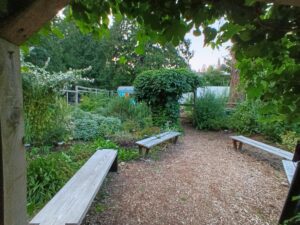
Gibsons Farm’s permaculture ‘pizza garden’s for camp learning, by Zoryan Ivakhiv-Gray
The GCA’s own community Food Forest and Nuts’a’maat Forage Forest have created many similar opportunities for engaging the community through volunteering opportunities, and giving back through products, seeds, education, inspiration, and the ecologically restored Millard Learning Center (MLC) containing a diversity of both wild and human-tended plants.
One of my favorite things to do when visiting the MLC is to wander around the beautiful Nuts’a’maat Forage Forest, see what’s growing, blooming, and bearing fruit, and nibble on some of the nodding onions or strawberries. This garden is such a great living representation of the complex relationships First Nations have had with the ecosystems we live in, and how a place that looks like a ‘wild’ ecosystem can bear unbelievably abundant food for us humans if we take care of it and build their diversity, while still providing a home for birds, bees, and other wildlife. Global systems like permaculture are in fact really just a synthesis of the systems and ideas indigenous and peasant peoples have developed over millenia, and I love how Nuts’a’maat has brought that back home to its roots.
After visiting all of these places, I always leave feeling inspired and uplifted, as they remind me that the Earth is still growing abundance no matter what climate chaos we have unleashed. All of them have cultivated and supported human communities, art, and culture around them, which they will help guarantee the resilience and survival of in challenging times to come.
Already in the Gulf Islands, it seems that ‘unconventional’ regenerative growing and food systems are becoming the norm, but it still helps to take a look around the other bioregions of the world when we’re able. While each ecosystem and human community faces different threats and stresses with climate change and biodiversity decline and will find their own unique solutions, finding parallels of historically-inspired creativity, adaptability, and education/inspiration of the human community, allows us to collectively further this movement of regeneration. I’m glad to end this growing season with a feeling of hope, and I hope others can too, especially living next to one of the leading organizations in biodiversity restoration and food systems development, the Galiano Conservancy Association.
–-