While some days in conservation are spent behind a desk, other days begin with the
fresh smell of cedar, the faint humming of a chainsaw in the distance, and boots sinking
into soft earth of a forest that has been patiently waiting for a second chance.
I recently joined our restoration team in the lower reaches of Beaver Creek, where we
prepared the site for the next phase of wetland restoration.
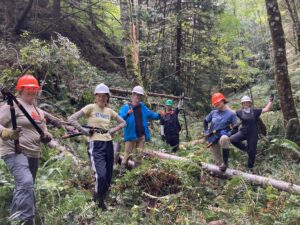
Restoration Team at Beaver Creek by Maroussia Odriozola
Walking through the forest, it was easy to imagine what this place once looked like.
Moss-covered trunks, towering conifers, shelves of turkey tail fungi, filtered soft morning
light, every fallen log alive with insects, and tiny organisms quietly doing the work of
decomposition. But beneath that beauty were signs of something that has been lost.
Years ago, beavers shaped this valley by building dams that slowed the flow of the
water, creating wetlands that supported amphibians, birds, and countless other species.
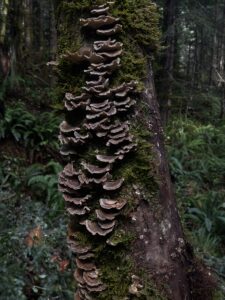
Turkey Tail Fungus at Beaver Creek by Marina Cousins
When the beavers disappeared, their dams gradually failed. The creek cut deeper into
the channel, the floodplain dried out, and much of that rich wetland habitat was lost.
Our goal is to help start that process again. We spent the day clearing new logging
debris and preparing the site for Beaver Dam Analogues (BDA’s) and Post-Assisted Log
Structures (PALS). These simple, low-tech structures are designed to mimic natural
beaver dams as well as log jams, slowing water and reconnecting the creek to its
floodplain. They are not meant to replace beavers but to create the
conditions that will encourage them to return.
One of the quiet highlights of the day came during a break in my work. A large Pacific
Sideband snail making its way across a mossy branch, completely unfazed by the
activity around it. This moment acts as a gentle reminder that restoration is not only
about charismatic species. Every healthy ecosystem depends on thousands of
organisms that are often unseen, from fungi breaking down fallen trees to snails
recycling nutrients through the forest floor.
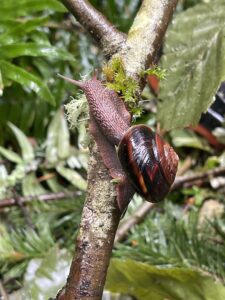
Pacific Sideband Snail at Beaver Creek by Marina Cousins
Nearby, shelves of turkey tail fungi climb an old trunk like a staircase, turning dead
wood into the foundation for new life. This also acts as a reminder that healthy
ecosystems depend on far more than the species we usually notice. Every organism
plays a role. In forests like this one, nothing goes wasted and everything becomes
habitat.
The most exciting part of this project is knowing that beavers are still active upstream. If
we can restore suitable habitat here, they will eventually do what they do best: build
dams, expand wetlands, and create habitat for wildlife far more effectively than we ever
could.
It’s not about engineering nature forever, It’s about giving nature the opportunity to take
over again.
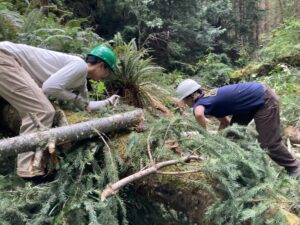
Kamilla and Abby working hard at Beaver Creek by Maroussia Odriozola
Standing in Beaver Creek at the end of the day, surrounded by piles of freshly cut
branches and towering trees. I could imagine what this place will become in the years
ahead. A creek spilling gently into wetlands and somewhere nearby, the unmistakable
splash of a beaver slipping beneath the surface of a pond it has built itself.
Restoration does not happen overnight. It unfolds one season, one storm, and one
small step at a time.
This was ours.
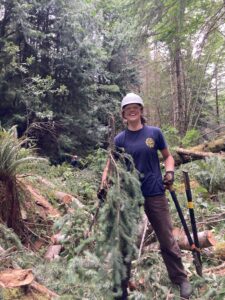
Kamilla at Beaver Creek by Maroussia Odriozola