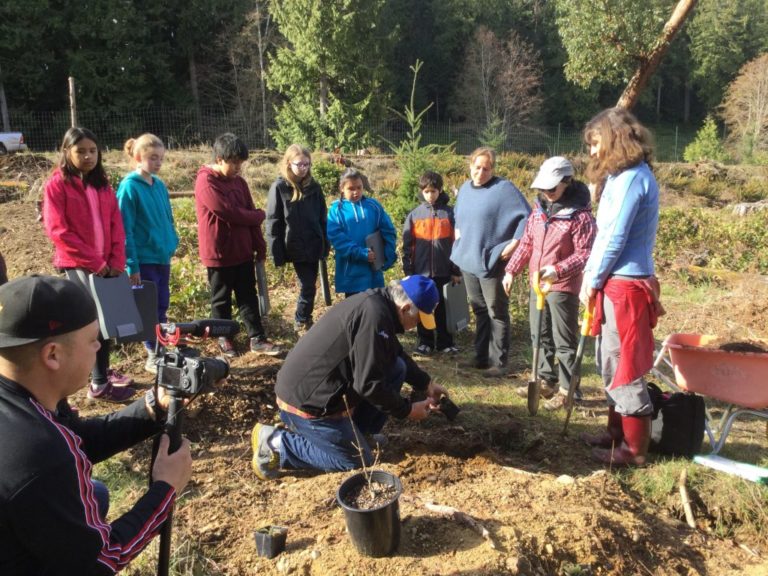
Q’úyél q’úwen – Restoring the Balance is an initiative of the Galiano Conservancy with a goal to improve the health and resilience of Galiano’s forest ecosystems and advance reconciliation with Indigenous people. Through collaboration, training, and shared knowledge, we work to heal both the land and historic relationships.
It sounds like a contradiction of the classic “save the trees” slogan, but on Galiano, cutting down a few trees is exactly what’s needed to save the forest.
Many of us are familiar with our island’s “dark and stark” stands: 30- to 50-year-old Douglas-firs packed so tightly that their canopies form a light depriving mat, leaving the understory sparse and lifeless. These are the legacy of late 20th-century clearcutting and plantations. Compare these to the “spacious and abundant” mature forests near Pebble Beach or the Bluffs, where light reaches the floor, where moss, ferns, shrubs, and trees of all ages thrive.
Our young forests are struggling. Dense growth and depleted soils lead to skinny stems, tiny crowns, dead branches laddering up the trunks, and a general lack of biodiversity. Crucially, these overcrowded stands are also high-risk for wildfire.
The Solution: Restorative Forestry
Remedying this requires thinning—lots of it. By strategically removing trees, we improve the health of the remaining ones, allowing them to spread their limbs and deepen their canopies. This “Variable Density Thinning” (VDT) mimics natural disturbances like wind and disease to create a diverse, patchy canopy that brings light to the forest floor. It breaks up fuel ladders that allow fire to climb into the canopy while encouraging a lush, fire-resistant understory of broadleaf trees and shrubs like salal.
This work is gaining momentum across the South Coast. Recently, I joined regional partners—including conservancy groups from the Gulf Islands and the San Juans, foresters, and government reps —for a Forest Restoration Workshop in Comox. We shared stories, learned from each other, and discussed how we can improve and promote forest restoration practice. We toured Qax mot, a restoration site managed by the Comox Valley Land Trust. There, they reduced tree density from 1,200 to 400 stems per hectare, using the felled trunks and chipped limbs and tops to create “assembled nurse logs”. These structures, inoculated with fungi to promote rot, mimic old-growth decay, holding moisture through dry summer months, and creating vital wildlife habitat.
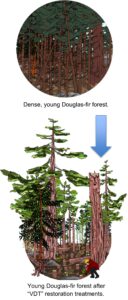
Forest Illustrations by Sylvie Hawkes
Local Action on Galiano
The Galiano Conservancy (GCA) is implementing similar tactics through the Restoring the Balance (RTB) project. RTB builds on the forest restoration work started in the Pebble Beach Reserve over 20 years ago, where VTD was employed in a 30-year-old Douglas-fir plantation. The current focus is on the GCA’s Quadra Hill Nature Reserve and in the Community Forest.
On Quadra Hill they’ve thinned stands and reduced the fuel load by relocating a portion of the downed wood to support a wetland restoration project in the lowlands of the property. They’re also busy creating assembled nurse logs like those demonstrated at Qax mot.
At the Community Forest, in partnership with the Galiano Club, the focus is on building local capacity to implement restorative forestry treatments. This site served as a BC Forest Safety Council training ground for community members to become certified fallers, a requirement for any forestry work in the province.
In the Community Forest, where sustainable harvest is permitted, they are also experimenting with resource recovery. A portion of the thinned logs are being processed for firewood or construction milling to see if sales can offset some of the costs of restoration. The goal is to make forest health and fire risk reduction accessible for private landowners across the island.
Both sites are part of a BC-wide study being conducted by Dr. Lori Daniels (Tree Ring Lab, UBC) and her research team to assess the efficacy of treatments to reduce wildfire risk and hazards. They measure and compare fuels in treated and untreated areas and use stand-level models to assess probability of fire and potential fire effects. This will give important feedback on how well the treatments are meeting fire risk reduction goals and will help improve future efforts.
Join the Conversation
Want to learn more? I’ll be giving a short presentation at the Galiano Club AGM on June 20th. Stay tuned for upcoming tours of our work sites in the Community Forest.
We gratefully acknowledge the financial contribution of the Victoria Foundation and Environment and Climate Change Canada – Nature Smart Climate Solutions Fund, which made this project possible.