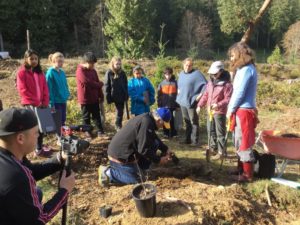
Penelakut Elder Augie Sylvester plants the first yarrow in the Nuts’a’maat Forage Forest, surrounded by Galiano Island youth
Before telling this story, I think it is important to acknowledge where I grew up. I was raised on Galiano Island, on the unceded and traditional territory of the Hul’qumi’num speaking peoples and the Penelakut First Nation. As a young, non-Indigenous person, I have had the privilege of growing up and witnessing the ongoing relationship between the Galiano and Penelakut communities, a relationship that is deeply woven into the story of the Nuts’a’maat Forage Forest.
In the Hul’qumi’num language, nuts’a’maat means ‘working together with one heart, one mind’. I do not speak for Penelakut or for Indigenous knowledge. What I can share is my own experience of growing up with this project, learning from the people who have helped shape it, and witnessing how these relationships have continued to grow over the years.
I was about twelve years old when the Nuts’a’maat Forage Forest was first established. Back then, it was a fairly barren patch of land. I remember meeting Penelakut Elder Augie Sylvester and spending time with the Penelakut students who would come over to Galiano. At school, we would learn, plant, eat and explore together. We were introduced to medicinal plants and traditional foods, learning not only what they were, but what they could offer us, how they could nourish, heal and connect us to the land. In reflection, I realize how special those experiences were, and how amazing it is to look back and see how much has grown.
The Nuts’a’maat Forage Forest itself grew out of relationships between Galiano and Penelakut. The roots of the project reach back to the Digital Forage project, which brought members of the Galiano and Penelakut Island communities together to share knowledge about traditional foods. Beginning in 2016, the Galiano Conservancy Association and Access to Media Education Society (AMES) worked with members of the Penelakut First Nation, including Augie Sylvester, through a series of meetings and conversations that helped shape the spirit and direction of the project.
I have had the privilege of growing up alongside some of this story and this August, something about it felt full circle. Over two consecutive days, I had the opportunity to sit with Augie and other Penelakut Elders as they came to the Learning Centre and spent time in the Forage Forest, sharing their knowledge with us. We gathered around the plants, listened to stories and teachings, and talked about medicine, healing, and the importance of maintaining relationships with the land.
This gathering was particularly meaningful because our relationship with Penelakut is continuing to grow in a new direction. The Forage Forest on Galiano has been part of a long relationship between our communities, and now there are plans for a medicinal healing garden on Penelakut Island as well.
In some small way, the garden that began here is growing and maturing in a new direction, the creation of another space for plants, healing, learning and community from the elders and knowledge holders who informed the Nuts’a’maat Forage Forest. That feels incredibly meaningful to witness, as someone who remembers this place before the garden existed, and has had the privilege of watching it grow alongside the relationships that made it possible.
The teachings also landed differently this time than they did when I was twelve. As we get older, sickness, aging and death become more real parts of our lives. We begin to think more about the people we love, about how we can care for them, and about how we care for ourselves. Sitting with the Elders and hearing about plants I had known since childhood, some of which had medicinal uses I had never learned or had forgotten, made me realize how much knowledge there still is to learn.
This reminded me of something I was introduced to when I was young: the importance of listening to Elders and paying attention to what the land already offers us. For me, that is one of the most powerful things about a medicine garden. It creates a place where knowledge can remain alive. Where children can learn what grows around them. Where people can gather, share, remember and reconnect. And where plants can be understood as more than something we simply walk past or buy from a store.
Nuts’a’maat has taught me that a garden can be much more than a garden. It can be a meeting place. A classroom. A source of food and medicine. A place for relationships to grow. For someone who remembers this place as nothing more than a patch of barren ground, seeing what it has now become, is awe-inspiring. The forest has grown over the years and in many ways, so have I. There is something beautiful about knowing that neither of us are finished growing yet.

Learning about plant medicine from esteemed Penelakut Elder Augie Sylvester, by Maroussia Odriozola