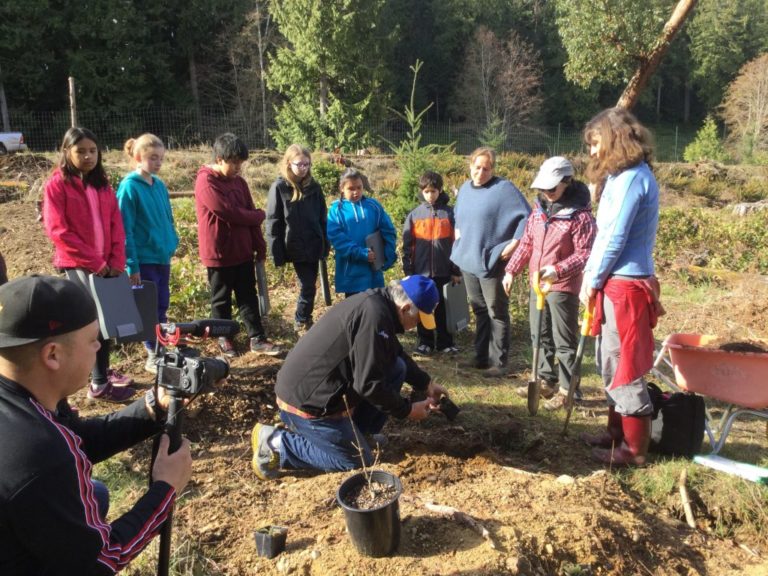

Marina Cousins doing restoration work at Quadra Hill
What if the first step to restoring a forest wasn’t planting more trees, but making room for more sunlight?
On Friday, July 31st, I spent the day at the Galiano Conservancy’s Quadra Hill restoration site, where what first looked like piles of branches and forest debris turned out to be something much more meaningful. It didn’t take long to realize that forest restoration isn’t always about producing more, but about creating the conditions that allow nature to recover on its own. Sometimes restoring balance doesn’t mean making a forest look tidy; it means giving it the space, light, and resources it needs to thrive.
Our job for the day was to clear the forest floor by gathering the sticks and wood debris left behind after the forest had been carefully thinned to allow more sunlight to reach the understory. At Quadra Hill, nothing goes to waste. We stacked the material into large piles, where nearly every piece of wood is given a second life. The smaller twigs and fine wood material can be transformed into biochar—a carbon-rich material that improves soils health by increasing water retention, supporting beneficial microbes, and storing carbon for the long term. Larger pieces are chipped and used to build
assembled nurse logs, an innovative restoration technique that recreates the ecological role of the fallen logs. These nurse logs provide habitat for insects and fungi, retain moisture, create ideal seedbeds for mosses, ferns, and native plants, transforming yesterday’s forest debris into tomorrow’s thriving ecosystem.
The best part of the day was realizing how even the smallest tasks contribute to something much larger. On the surface, we were simply moving branches from one place to another, but every pile we built was helping prepare the next page of the restoration process. It gave me a new appreciation for the amount of planning, research, and hands-on work happening behind the scenes at Quadra Hill. One of the most fascinating aspects of the project is that it isn’t just restoring a forest—
it’s also conducting an experiment.
The Conservancy is testing a variety of restoration techniques, including variable density thinning, biochar production, and assembled nurse logs, to better understand which approaches most effectively help young forests regain the structure and function of healthy ecosystems. Each treatment area is carefully monitored over time, allowing the forest to reveal what works best. Every season provides new insights into an important question: how can we restore the balance and bring back the qualities of a healthy forest supporting greater biodiversity and long-term resilience?
It was exciting to learn that the piles of branches we spent the day moving weren’t simply forest waste. Instead, they will become an important part of the next stage of restoration, enriching the soil, creating habitat, storing carbon, and supporting new life.
Restoration doesn’t look the way you would expect, but after spending a day at Quadra Hill, it is easy to see that every branch, every canopy gap, and every experimental idea plays a role in helping restore the balance.
If you (or someone you know) wish to become one of restoration volunteers please contact Adam Huggins, GCA Restoration coordinator, at adam.huggins@galianoconservancy.ca.
FOR A MORE IN-DEPTH ARTICLE ABOUT THE QUADRA HILL RESTORATION PROJECT, CLICK HERE.
TO VIEW A STORY MAP OF THE QUADRA HILL RESTORATION PROJECT, CLICK HERE.