On November 1st and 2nd of this year, Galiano Conservancy staff and volunteers gathered together with Indigenous Knowledge Holders to hold the 6th annual Feed the People, a deer butchering and processing weekend workshop focusing on local food resilience.
This program was begun in 2019 by Karen Charlie, an esteemed elder and Knowledge Holder from Penelakut First Nation. Karen has since passed away, but her legacy continues through several generations of her family members. The hunters and instructors this year included Rosemary Georgeson, Richard Charlie, Jaime Charlie, Alvin James, Janzen “Baldy” Edwards, Brandy “Sil” Johnson, and Adeen Jim–as well as 3 year old Seraphine, who was a delightful and helpful presence during the workshop!
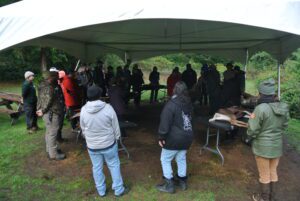
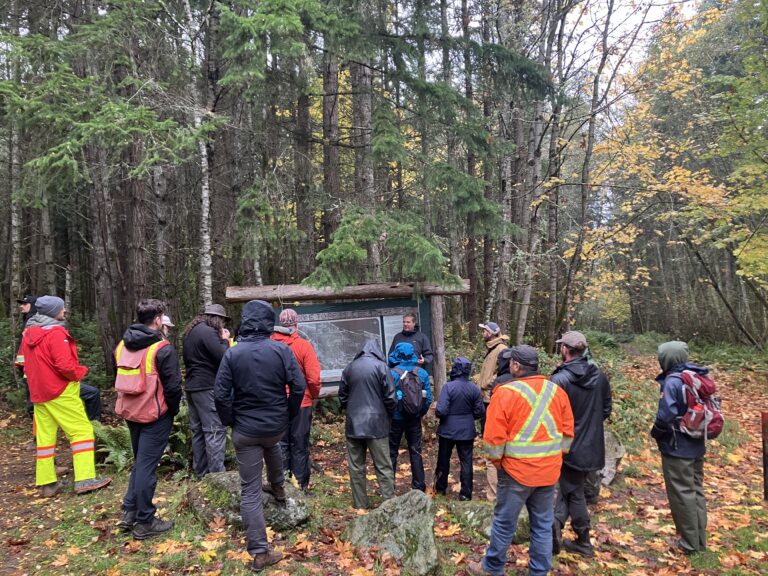
Gathering around the deer before beginning the butchering process
Seven Columbian black-tailed deer were harvested from the Millard Learning Centre as well as from participating private properties across the island in advance of the workshop. On the first day, we skinned, deboned, and cubed the deer. On the second day, we processed 76 cans of cubed venison in pressure canners, and used a meat grinder to make sausages and ground venison. Each attendee went home with several jars of freshly canned venison, and a bag of ground meat or sausages. If stored safely, the canned venison lasts almost indefinitely without the need for refrigeration, making it a high quality protein particularly suitable for the power outage-prone Southern Gulf Islands!
The 24 participants included several repeat attendees from past years, many members of the Galiano Community, as well as visitors from further afield on Vancouver Island and mainland BC. Three staff from BCWF (BC Wildlife Federation) were in attendance , as well as a student from the UBC Conservation Decisions Lab. Martine Paulin, the GCA’s Development Coordinator, was also on hand sharpening knives with whetstones. I was one of three volunteers on hand to help keep the weekend running smoothly, alongside Demi Kelly and Raphaël Gasc.
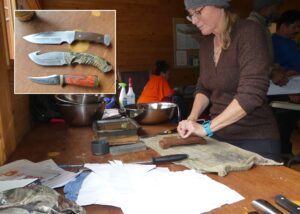
Martine Paulin sharpening knives.
My hope was to learn more about–and be more involved in–the journey that takes a deer from the woods to the table. Although a few people in my life are hunters, before this workshop I had never skinned or processed an animal (not owning a hunting knife prior to this, I purchased one the day before and promptly sliced my finger open trying to unwrap it in the car!), and I wondered what the experience would be like. I knew that for many participants this was a new experience and a step out of our collective comfort zones. However, the patient and clear guidance from the instructors soon turned nerves into confidence as we gathered around the tables, four or five people to each deer, and began skinning the animals together.
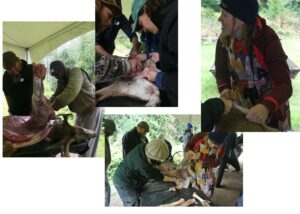
Making the first cuts!
Our teachers taught us to give thanks for the deer by laying a hand on the body before making the first cut, and showed us how to use almost all parts of the animals- hooves were kept for making rattles, some organs (such as liver) were saved for food, bones for broth, and antlers for traditional stick games. The hides will be returned to Penelakut Island for future processing, eventually becoming drumskins. I learned from Jaimie Charlie that traditionally, when a hunter-in-training harvests their first deer, they take a bite from the fresh liver during the field dressing to mark the transition from trainee to hunter.
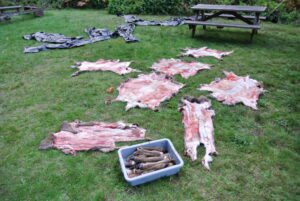
Hides and hooves saved for tanning and rattles.
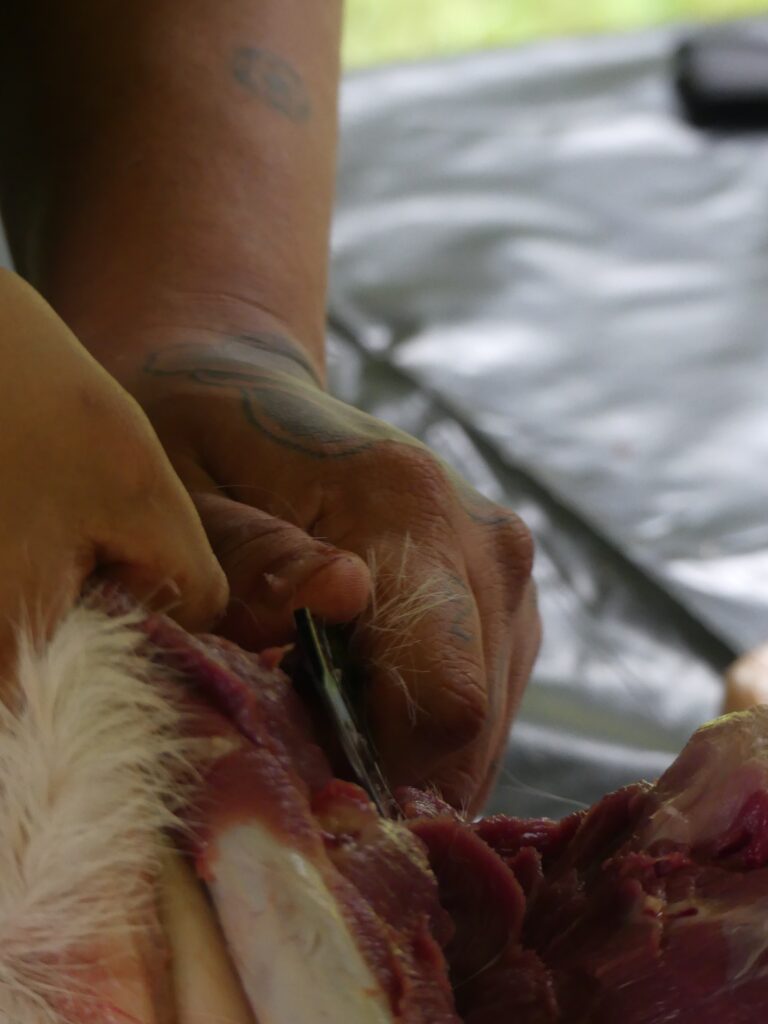
Jaime demonstrates separating a hindquarter
A core tenet of this event is the Hul’qumi’num word nuts’a’maat–working together with one heart and one mind– and this was felt keenly by all present, as we worked together in the classroom at one shared table to debone, cube, and jar the meat. With the woodstove going and rain outside, it was an opportunity to share stories, advice, and laughter with our neighbours.
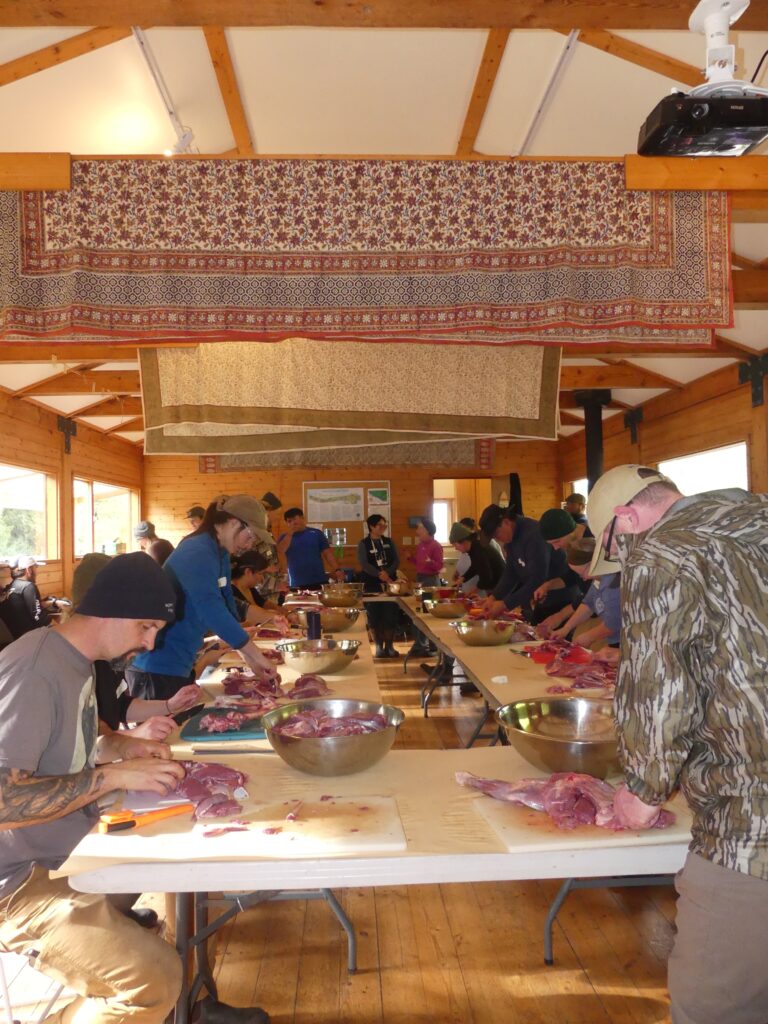
Deboning and cubing the venison together.
Baldy guides participants in deboning the meat.
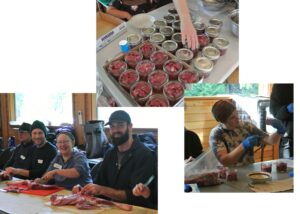
Assembling the jars of meat for canning.
This year’s event was coordinated by Adam Huggins and Bobbi-Jo Basarab, who are leading the ongoing Restoring the Balance project. This multi-year project focuses on bringing together reconciliation and stewardship–working together to improve the health and resilience of Galiano’s forest ecosystems through community-led stewardship activities and training opportunities with local Indigenous rights holders. RTB has three components: Stewardship of Forests; Stewardship of Island Deer; and Stewardship of the Understory. Feed the People helps to restore balance to island deer populations, and creates opportunities for food sovereignty and knowledge sharing, in line with RTB’s purpose.
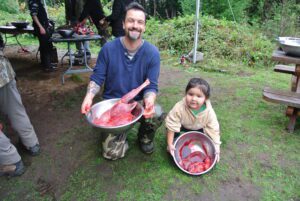
Seraphine helps carry organs into the kitchen!
A recent study by McComb et al., summarized clearly in this Narwhal article, finds that the overabundance of deer in the Southern Gulf Islands is “pushing rare ecosystems to collapse, and Indigenous hunting could be the most effective path to recovery.” The ecological impacts of unchecked deer populations–brought on by the loss of predators and the decline of hunting–affect the biodiversity, ecosystem resilience, and even the health of the deer themselves on the Gulf Islands, as the deer’s grazing damages arbutus trees, highly endangered Garry oak ecosystems, and plants that pollinators need to survive. Creating space for Indigenous-led hunting to bring deer populations down to healthy levels, and to provide a high-quality local food source, is crucial in the restoration and protection of island ecosystems and communities.
This workshop was funded in part by the Government of Canada and in part by Heritage BC through the Heritage Legacy Fund. Support was also provided by the Community Impact Grant and the Gencon Foundation. We extend our appreciation to our longtime partners with the Galiano Community Food Program and the Access to Media Education Society, as well as to Galiano Courier for the use of a refrigerated truck! For a detailed dive into the experience of Feed the People, and the ecological benefits of Indigenous-led deer hunting, check out this Salish Harvest article by Kendall McLaughlin, one of this year’s participants. For 2026 Feed the People registration, follow this page.
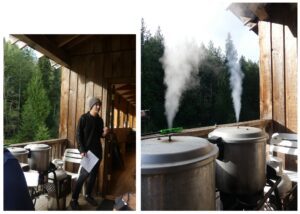
Adam manning the pressure canners.
In a time where our society is increasingly becoming isolated from our food sources and from the natural world, it is deeply meaningful to learn in community and be part of something so raw and real. I am thankful to have had the chance to participate in this workshop and gain new skills and knowledge of local food systems and traditions. Along with the GCA, I am grateful to all those who made this weekend of knowledge and growth possible, and look forward to more opportunities to learn and share on this land.
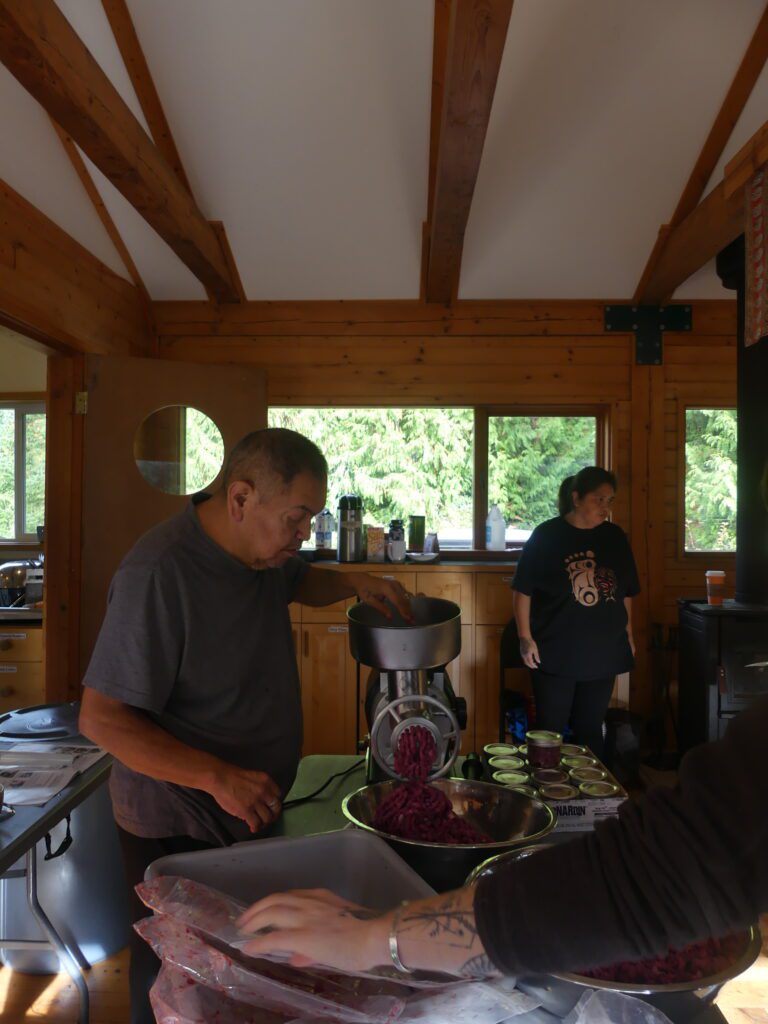
Richard Charlie making sausages.
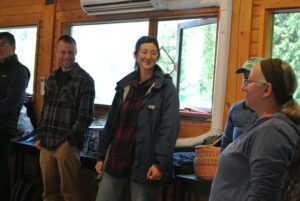
Participants reflecting after the workshop.
Photo credit: Kendall Mclaughlin, Lúthien Teel, and Raphaël Gasc.