Each early summer, Nootka rose (Rosa nutkana) brightens hedgerows, meadows, and coastal thickets with soft pink blossoms. It is easy to admire and move on, but for Coast Salish Peoples and other Indigenous communities across the Pacific Northwest, this plant has long carried much deeper meaning.
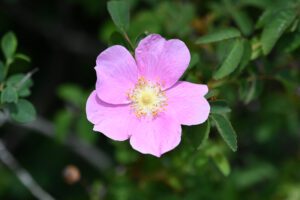
Close-up of a Nootka rose flower.
Image by Meadow Lore (Wikimedia Commons)
In Hul’qumi’num, the plant is called qel’qulhp, and its flower, qelq. In spring, Coast Salish harvesters gather the young shoots, peel them, and eat them fresh. The shorter, pinkish-red shoots (specially those growing in sunny spots) are considered particularly sweet.
Later in the season, the plant’s bright red hips become food as well. One cherished preparation combines the flesh of fresh rose hips with fresh salmon eggs as a ceremonial food, bringing together two seasonal gifts of the coast (Source: NOAA Fisheries website). Rose hips are also used for tea, syrup, and jelly, and are rich in vitamin C. Nootka rose also plays a role in healing. A decoction of leaves, roots, and bark is used as a body and hair wash after sweat-bath use, while a root infusion serves as an eyewash. The rose hips are cooked and used to treat diarrhea. A tonic tea is made from the petals, leaves, branches and inner bark. The leaves are used as a poultice for bee stings (Source: Plant teachings from my auntie, by Geraldine Manson, C’tasi:a, Nancy J. Turner). Bark decoctions are also taken to help ease childbirth pains.
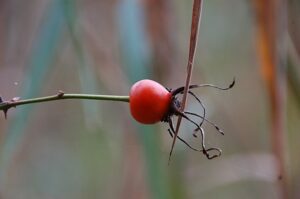
The fruit of a Rosa nutkana specimen (AKA rosehip).
Image by Gunnar Bonk (Wikimedia Commons)
These practices reflect a careful, place-based knowledge of the plant and its seasons. The plant is practical, too. Its strong roots are used for cordage and fishing line, and are reported as material for reef nets. Branches and leaves can flavour or protect food during cooking. Nootka rose also appears in ceremony. In some traditions, branches are used to sweep gravesites before burial, carried as good-luck charms, or used to remove human scent before hunting. Among the Hanaksiala north of Vancouver Island, costumes covered in blooming Nootka roses and other flowers are worn during a new-year celebration around March.
Today, Nootka rose remains a lovely plant to notice, and a reminder that the species around us hold stories, relationships, and responsibilities. The term “Coast Salish Peoples” includes many distinct Indigenous Nations and communities, and knowledge and practices vary by place. If you would like to learn more about local Indigenous plants or harvest respectfully, connecting with the applicable Nation or a local Indigenous-led harvest or restoration program is the best first step.
–-